Owners Club · Digital service history
BMW iX1 Owners Club — Maintenance & Provenance
Independent owners’ resource. This page is produced by The Owners Club and is not affiliated with, endorsed by, or sponsored by BMW AG or BMW UK. Information below is gathered from public sources and should be confirmed in your vehicle handbook (VIN) or with an authorised BMW retailer before booking work. The iX1 is BMW’s fully electric compact Sports Activity Vehicle in the U11 X1 family — production from 2022, with eDrive20 joining from Nov 2023 and a spring-2026 silicon-carbide (SiC) power-electronics efficiency stage inside the same U11 generation. It is not a combustion X1 with a battery swap badge — it has its own electric U11 member page in BMW’s line-up.
Own an iX1? Build a digital record of battery health, charging history, service events, software/OTA updates, brake/tyre work and ownership documents. The strongest product path here is EV knowledge → battery & charging record → digital service history → provenance → Transfer Pack.
Arrived from a club search? See the exact-match BMW iX1 Owners Club landing — then use this hub for platforms, issues and the full guide cluster.
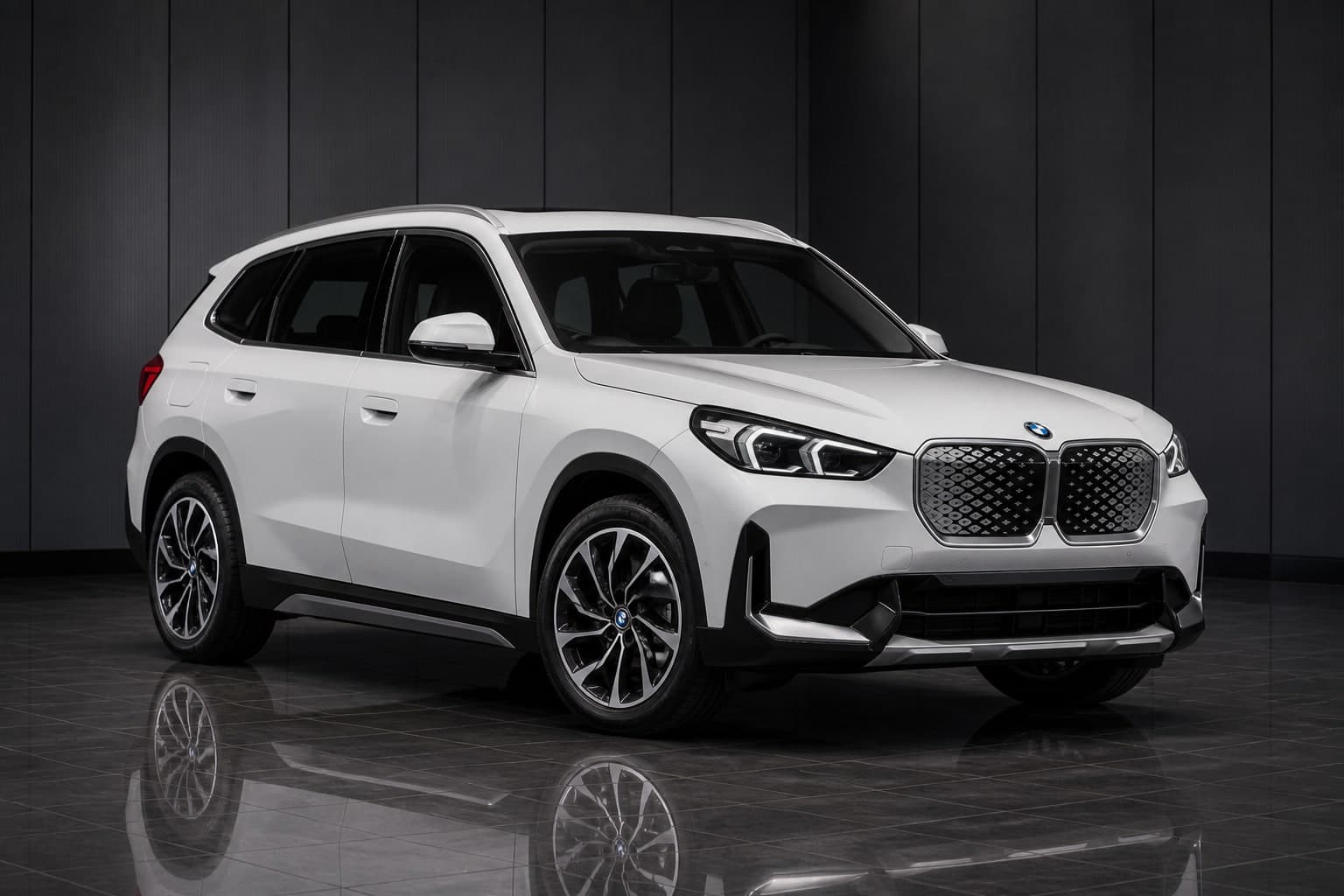
Latest iX1 News
Updated 2026- Technical stage / efficiencyEurope / Global
Spring 2026 SiC efficiency update
BMW’s spring-2026 silicon-carbide power-electronics update improves efficiency and WLTP range within U11 — German announcement up to 514 km eDrive20 and 466 km xDrive30. A technical stage, not a new generation.
2026BMW Group / technical
- Software / infotainmentGlobal
Operating System 9 & QuickSelect
Later iX1 production adopts BMW Operating System 9 with QuickSelect and the Curved Display pairing (10.25-in instrument cluster + 10.7-in central display) — a software/hardware stage inside U11, not a new generation.
2023/24BMW Group / product
- Derivative launchGlobal
eDrive20 joins the iX1 line-up
From Nov 2023 BMW added eDrive20 — 150 kW / 204 hp single-motor FWD with 64.78 kWh usable battery — expanding the U11 iX1 range alongside xDrive30 AWD.
2023BMW Group / model launch
Read first — U11 electric SAV ownership framing
For iX1, the most important ownership data is battery health, charging history, software/OS9 generation, technical stage (launch → 2023/24 OS9 + eDrive20 → 2026 SiC), thermal management, 12V, high-voltage systems, brakes/tyres, service history, recalls and market-specific specifications. Do not invent U12 or a second generation for 2026. Do not treat one market’s WLTP miles as global law. The iX1 is related to the wider U11 X1 family but is its own electric model page — not “just an electric X1” without separate provenance fields.
1. Generations & platform
U11 — one generation (2022–present)
One production generation for the iX1. Built on FAAR/UKL2-derived architecture with fifth-generation BMW eDrive. Launch began with xDrive30; eDrive20 joined from Nov 2023 with Operating System 9 as the software baseline on later production. The iX1 is the electric member of the U11 X1 family — separate model identity from combustion X1 derivatives but shared U11 platform context.
Technical stages inside U11 (not new generations)
Launch xDrive30 (2022 European introduction) → 2023/24 OS9 / QuickSelect / Curved Display + eDrive20 production → spring-2026 SiC power-electronics efficiency update (German WLTP announcement up to 514 km eDrive20 / 466 km xDrive30). These are product/technical stages — not U12 and not a second iX1 generation code for The Owners Club V1 taxonomy.
Market naming, equipment and exact outputs vary. Always tie power, battery, range and charging figures to derivative, production stage and market — confirm VIN. Combustion X1 discussions may be platform-adjacent at lower relevance; never assume identical parts or service identity.
2. Body style
Five-door compact Sports Activity Vehicle (SAV)
Single body style — compact electric SAV silhouette shared with the U11 X1 footprint. Five-seat configuration depending on market specification. Flat high-voltage battery in the floor; eDrive20 is FWD, xDrive30 is electric AWD.
3. Battery & high-voltage system
Always distinguish gross capacity from usable/net capacity and published headline figures from VIN-specific values. The iX1 uses a ~65 kWh class pack across derivatives — exact usable values differ slightly by derivative and document.
- Launch xDrive30: BMW published 64.7 kWh usable in European launch technical data — confirm market sheet
- eDrive20: BMW published 64.78 kWh usable in launch/UK technical framing — confirm VIN
- UK market often describes a ~65 kWh battery class — tie to usable vs gross/published wording on the official sheet, not forum shorthand
- Record warranty status, SoH diagnostics, HV warnings and battery-related repairs as separate provenance — never infer health from displayed range alone
Battery chemistry, BMS behaviour and charging curve details should come from BMW documentation for the VIN — do not invent one universal “iX1 battery size” for every market and stage.
4. Derivatives & powertrains
Two primary derivatives — eDrive20 (FWD) and xDrive30 (electric AWD). xDrive30 system output varies by production stage in published BMW tables; keep both values as stage-bound facts, not two generations.
eDrive20 — front-wheel drive
Single-motor FWD derivative from Nov 2023 production. BMW published: 150 kW / 204 hp · 250 Nm · 0–62 mph in 8.6 s · 170 km/h / 106 mph · 64.78 kWh usable · DC up to 130 kW · AC 11 kW standard / 22 kW optional where offered. Efficiency-oriented choice within U11.
xDrive30 — dual-motor electric AWD (launch framing)
Dual-motor electric all-wheel drive. Launch/boost specification in BMW documents: 230 kW / 313 PS · 494 Nm · 0–62 mph in 5.6 s · 180 km/h / 112 mph · ~64.7 kWh usable class · DC up to 130 kW · AC 11/22 kW as equipped. Higher kerb weight and towing rating than eDrive20 on UK sheets — config-specific.
xDrive30 — published outputs by production stage (same U11 gen)
CRITICAL: keep BOTH published system outputs as stage-bound values within one U11 generation — launch/boost docs: 230 kW / 313 PS · 494 Nm; spring-2026 SiC German technical table: 225 kW / 306 hp · 494 Nm. Same dual-motor AWD architecture — bind kW/hp to production stage + market sheet, not to a invented U12 or second generation. Wheels, software and SiC stage also affect range.
Exact outputs, range, kerb weight and equipment are model-year, stage and market specific. Use the market selector for regional framing — do not treat one country’s sheet as global.
5. Charging
- AC charging: 11 kW standard onboard framing in BMW docs · 22 kW optional where offered — confirm onboard charger on VIN
- DC fast charging: up to ~130 kW under suitable conditions — not 350 kW-class peaks
- BMW documents roughly 10–80% in ~29 minutes DC with battery pre-conditioning where equipped
- Pre-conditioning (manual or navigation-linked where available) materially affects DC session speed — log behaviour in charging history
- Home AC examples (eDrive20 launch framing): ~6.5 h at 11 kW / ~3 h 45 at 22 kW from empty to full — market and wallbox dependent
Actual performance depends on SoC, battery temperature, charger capability, preconditioning, ambient temperature, station load and vehicle software. Log home wallbox, AC/DC sessions, duration, provider and interruptions separately from workshop service stamps.
6. Range — WLTP vs real-world
Always distinguish official test range from real-world distance. Official figures are not guaranteed trip distances and vary by derivative, stage, wheels and market.
- UK WLTP miles (market-labelled examples): eDrive20 297–318 mi · xDrive30 269–289 mi — confirm current BMW UK sheet and wheel specification
- Launch EU xDrive30 WLTP: ~417–440 km class in BMW European launch documentation — not a global mile figure
- eDrive20 provisional EU WLTP framing: ~430–475 km depending on specification and publication date — confirm VIN sheet
- Spring-2026 SiC German announcement: up to 514 km eDrive20 / 466 km xDrive30 WLTP after efficiency update — stage-bound, not a new generation
- Real-world distance is lower in winter, at motorway speed, with larger wheels, heavy load or sustained HVAC — do not infer battery health from one trip
Range is affected by speed, temperature, weather, wheel/tyre specification, load, HVAC, driving style, battery temperature, SoC, production stage and options. Never copy one country’s WLTP sheet onto another market.
7. Recuperation & braking
Regenerative braking recovers energy during deceleration and coordinates electric and friction braking. One-pedal / recuperation settings vary by mode and software. Regen reduces conventional brake use but does not eliminate inspection of discs, pads, calipers, fluid, lines and corrosion — low-mileage EVs can still develop disc corrosion if friction brakes are used infrequently.
8. Software & infotainment
Software is a core ownership component. Later iX1 production aligns with BMW Operating System 9, QuickSelect and Curved Display (10.25-in instrument + 10.7-in central) — but early launch xDrive30 cars predate the full OS9 rollout.
- Track softwareVersion, iDrive/OS generation, QuickSelect availability, OTA/dealer update dates and campaign IDs
- OS9 / QuickSelect: revised operating concept and menu structure on equipped cars — record whether the vehicle has the Curved Display pair
- OTA and dealer updates can change charging, ADAS and connected-service behaviour — log version at time of any fault or repair
- Do not assume model year equals software generation — confirm in iDrive or workshop printout
Infotainment, navigation, ADAS calibration and connected services evolve with software. Keep software provenance beside charging and service records.
9. Dimensions & weights
Compact SAV footprint shared with U11 X1 class. Weights, payload and towing are derivative-specific — confirm the VIN market sheet before assuming capacity.
- Length / width / height: 4500 / 1845 / 1616 mm (typical U11 iX1 published dimensions)
- Wheelbase / track (approx.): 2692 / 2104 mm — confirm market technical data
- Boot volume: 490–1495 L depending on seat position (market-labelled BMW figures)
- UK eDrive20 (config-specific examples): kerb ~1940 kg · GVW 2435 kg · payload 570 kg · roof load 75 kg · braked towing 750 kg
- UK xDrive30 (config-specific examples): kerb ~2085 kg · GVW 2580 kg · payload 570 kg · roof load 75 kg · braked towing 1200 kg
- Towing, roof load and kerb weight vary by derivative, options and market homologation — never assume xDrive30 weights on an eDrive20 VIN or vice versa
Published dimensions and weights are configuration-specific. Use official BMW technical data for the VIN rather than owner-estimated values.
10. Honest pros
- Proper electric U11 member — compact SAV packaging with usable boot space for the class
- eDrive20 adds an efficiency-oriented FWD choice alongside xDrive30 AWD
- DC ~130 kW and optional 22 kW AC are adequate for daily and motorway use when preconditioning is used
- OS9 / QuickSelect / Curved Display on later production improves the ownership interface vs early launch cars
- 2026 SiC stage improves efficiency/range within the same U11 generation — meaningful stage provenance for resale
- Strong provenance potential when battery, charging, software stage, service and ownership records are clear
11. Honest cons / things to consider
- Specification variation — derivative, stage, software, wheels and market sheets differ materially by VIN
- DC peak ~130 kW is modest versus newer 800V / 350 kW-class EVs — plan longer motorway stops
- Range sensitivity — cold weather, motorway speed and wheel choice can materially reduce real-world distance
- xDrive30 published kW/hp changed between launch and 2026 SiC docs — buyers need stage clarity, not generation confusion
- Regenerative braking can leave friction brakes under-used — inspect for corrosion on low-mileage cars
12. Common owner-reported themes
Not diagnostic advice — these are discussion categories owners may document. Do not treat them as confirmed defects unless supported by manufacturer documentation, recalls or reliable technical evidence.
Charging
DC session speed vs ~130 kW headline, preconditioning behaviour, AC 11 vs 22 kW wallbox compatibility, public-charger handshakes and session interruptions.
Battery
Range variation, SoC behaviour, battery temperature, perceived health and thermal-management behaviour — keep diagnostics separate from trip estimates.
Software
OS9 / QuickSelect quirks, iDrive freezes, OTA updates, connected services, navigation and smartphone integration.
12V system
Low-voltage battery condition, wake/sleep behaviour and auxiliary electrical systems — weak 12V can mimic HV faults.
Chassis & ride
Compact SAV ride quality, tyre noise, suspension wear and alignment on torque-rich EVs — especially with larger wheel options.
Brakes
Disc corrosion from regen under-use, pad/disc wear, fluid age and brake feel.
Tyres & wheels
Wear on a torque-rich EV, load/speed ratings, winter/summer setups, wheel size efficiency trade-offs and range impact.
13. Service & maintenance (EV)
Do not copy an ICE X1 oil-service schedule onto an EV. BMW iX1 follows Condition Based Service (CBS) — intervals and inspection requirements vary by market, model year and derivative. Always verify the VIN-specific BMW maintenance schedule in iDrive.
| Item | Typical interval | Notes |
|---|---|---|
| Scheduled EV inspection / service (iX1) | CBS — often annual / ~10,000–12,000 mi (confirm iDrive) | U11 CBS — do not invent a universal miles interval. Whichever the dealer system / iDrive shows for this VIN. Not combustion X1 oil changes. |
| Brake fluid | CBS (often ~24 months) | Fluid absorbs moisture even when regen reduces pad wear. |
| 12V battery test | Every service / sooner if symptoms | Load-test — separate from HV pack provenance. |
| Cabin / pollen filter | CBS / often ~12 months | Annual habit on most EVs. |
| Tyres & alignment | Regular / every service | Compact SAV EV + torque; load/speed ratings and wheel choice affect range. |
| Brake pads / discs / corrosion | Every service | Regen can leave discs under-used — inspect for corrosion. |
| Suspension & steering | Every service / as needed | Dampers, bushes, alignment — log with invoices. |
| Coolant circuits / thermal system | Per BMW schedule | HV and cabin thermal loops — specialist EV work; log pre-conditioning faults. |
| High-voltage system inspection | Per BMW schedule / campaign | Authorised EV technician — log warnings and repairs. |
| Software / OTA check | At service or when prompted | Record OS/iDrive version + date in Digital Service History (OS9 / QuickSelect on later stages). |
| Battery health / diagnostic (where offered) | Owner / dealer / third-party | Separate provenance event — not “range looks fine”. |
| Charging system / port / cable | Every service / as needed | AC 11/22 kW and DC ≤130 kW session notes belong in charging history. |
Service intervals and inspection requirements vary by market, model year, derivative and production stage. Always verify the VIN-specific BMW maintenance schedule.
14. EV battery health & provenance
Battery health is a first-class provenance category for iX1. Distinguish manufacturer diagnostic results, owner-reported range estimates and third-party battery tests.
- SoH % / diagnostic report, date, mileage, test provider
- Charging behaviour notes and software version at test time
- Warranty status, HV warnings, module repairs and battery-related work
- Production stage (launch / OS9 / SiC) and wheel specification at test time
- Store documents against the vehicle for resale / Transfer Pack
Never infer battery health from displayed range alone. Charging records should stay separate from workshop service stamps.
15. Inspection & roadworthiness
Terminology adapts by country — never title every market’s test “MOT”. UK MOT, Spain ITV, Poland/Hungary periodic inspection, Turkey TÜVTÜRK, US state systems, and other local rules.
- Record the local certificate separately from manufacturer service stamps
- Use the market selector for the local system name and authority links
- EV-specific items (HV isolation warnings, tyre/brake condition, suspension) still matter at inspection
- Do not conflate a passed periodic inspection with a full BMW CBS EV service stamp
Confirm requirements for the vehicle’s registration market.
16. Recalls & campaigns
- Check VIN on official BMW / national safety portals for your market
- Log campaign ID, completion date and software version after work
- Do not assume a campaign from one market applies to every iX1 worldwide
Recall and campaign availability can vary by market, production date, software version and VIN. Never display “this car has no recalls” unless the specific VIN has been checked against an authoritative source.
17. Safety ratings
Euro NCAP tested the U11 BMW X1 in 2022 (five-star result for the wider U11 programme). The iX1 was added to the rating scope after the initial publication — electric-specific safety context should be read on the Euro NCAP listing for the iX1 variant, not assumed identical to every ICE X1 derivative without checking.
18. Official resources
Official links are for convenience. The Owners Club has no commercial relationship with BMW AG. Confirm manuals, charging and battery terms against your own documentation. Prefer VIN-specific BMW Owner’s Manual lookup over invented deep links.
- BMW UK — model technical data, charging, battery, range and equipment (use BMW’s official UK technical pages for your derivative)
- BMW Group PressClub — public technical announcements including OS9, eDrive20 and SiC efficiency updates
- GOV.UK / DVSA — UK recall and vehicle safety checks (VIN-based)
- Euro NCAP — U11 X1 / iX1 safety rating listing (read iX1 scope notes on the official result page)
19. Buying a used iX1
- Identity: VIN · model year · derivative (eDrive20 / xDrive30) · production stage (launch / OS9 / SiC) · market · options · import history
- Battery: health evidence, warranty, HV warnings, charging performance, repairs/replacements — usable vs published capacity wording
- Charging: AC/DC test where practical, connector/flap, cables, charging history, preconditioning behaviour, 11 vs 22 kW onboard charger
- Chassis: tyres, uneven wear, brakes, suspension, steering alignment — wheel size affects range and ride
- Electrical: 12V load-test history, stored faults, Curved Display / cameras, ADAS, climate/heat pump where fitted
- Software: OS/iDrive version, QuickSelect, OTA/dealer campaigns, connected services — do not assume MY = OS9
- Stage clarity: launch xDrive30 (230 kW/313 PS docs) vs 2026 SiC table (225 kW/306 hp) — same U11 gen, different published outputs
- Body: paint, panel gaps, underbody, accident repairs, charging-port area condition
- Documents: BMW service history, invoices, recalls, battery reports, charging records, inspections, keys, manuals
- Range expectations: compare WLTP sheet to wheel specification and climate — reject single-trip “health” claims
- Weights/towing: confirm kerb, payload, roof load and braked towing for the derivative (eDrive20 vs xDrive30 differ)
- Test drive: verify DC session behaviour, ADAS, regen modes, 12V wake behaviour and iDrive version before purchase
20. Own an iX1? Protect its resale value
For a compact electric SAV, the ownership story is more than mileage. Battery health, charging history, software stage, servicing, brake/tyre records and documented repairs can all become part of the vehicle’s provenance. Know your car. Record its history. Connect with owners. Keep its story.
- Add iX1 to Garage — free digital ownership record
- Record battery health, charging history and OS/iDrive software versions
- Track CBS servicing, inspections, repairs, tyres/brakes and recalls with invoices
- Note production stage (launch / OS9 / SiC) and derivative in the Garage profile
- Log preconditioning behaviour and DC session notes as charging provenance
- Build a Transfer Pack for the next owner
Guides & checklists
More BMW models
Compare platforms, service themes and digital service history tools across the range.
FAQ
Is the BMW iX1 separate from the combustion X1?+
Yes. The iX1 is the battery-electric member of the U11 X1 family with its own model identity, derivatives (eDrive20 / xDrive30) and electric-specific specification. It shares U11 packaging but is not interchangeable with ICE X1 service or charging assumptions.
Is there a U12 iX1 generation?+
No. For The Owners Club V1 taxonomy there is one U11 iX1 production generation (2022–present). Do not invent a U12 code for the 2026 SiC update.
Is the 2026 iX1 a new generation?+
No. BMW’s spring-2026 SiC power-electronics update is a technical stage within U11 — improved efficiency and WLTP range (German announcement up to 514 km eDrive20 / 466 km xDrive30) but not a second generation.
Does every iX1 have xDrive?+
No. eDrive20 is front-wheel drive with a single motor. xDrive30 is dual-motor electric all-wheel drive. Confirm derivative on the VIN — do not assume AWD from the iX1 badge alone.
Do all iX1 derivatives share the same battery and range?+
No. Battery usable figures, published range and real-world distance vary by derivative, production stage (launch / OS9 / SiC), wheel/tyre specification and market WLTP sheet. Tie figures to VIN and stage — never copy one country’s miles globally.
Does every iX1 charge at 22 kW AC?+
No. 11 kW AC is the standard onboard framing in BMW documentation; 22 kW AC is optional where offered. Confirm onboard charger and wallbox capability on the VIN.
iX1 owner discussions
Latest conversations from BMW iX1 owners in the club.
No discussions yet for the iX1. Be the first owner to start a conversation!
Ask a Question / Post PhotoJoin the BMW Owners Club Community
Add it to The Owners Club for free to track its maintenance timeline, import UK MOT history, and transfer verified provenance when you sell.