Owners Club · Digital service history
Audi Q8 e-tron Owners Club — Maintenance & Provenance
Independent owners’ resource. This page is produced by The Owners Club and is not affiliated with, endorsed by, or sponsored by Audi AG or Audi UK. Information below is gathered from public sources and should be confirmed in your vehicle handbook (VIN) or with an authorised dealer before booking work. The Audi Q8 e-tron is the evolution of Audi’s first series-production fully electric model, the Audi e-tron (2018). The family was substantially updated and renamed Q8 e-tron for the 2023 model year. Production at Audi Brussels ended at the end of February 2025.
Own a Q8 e-tron or earlier e-tron? Build a digital record of battery health, charging history, service events, software/OTA updates and ownership documents. The strongest product path here is EV knowledge → battery & charging record → digital service history → provenance → Transfer Pack.
Arrived from a club search? See the exact-match Audi Q8 e-tron Owners Club landing — then use this hub for platforms, issues and the full guide cluster.
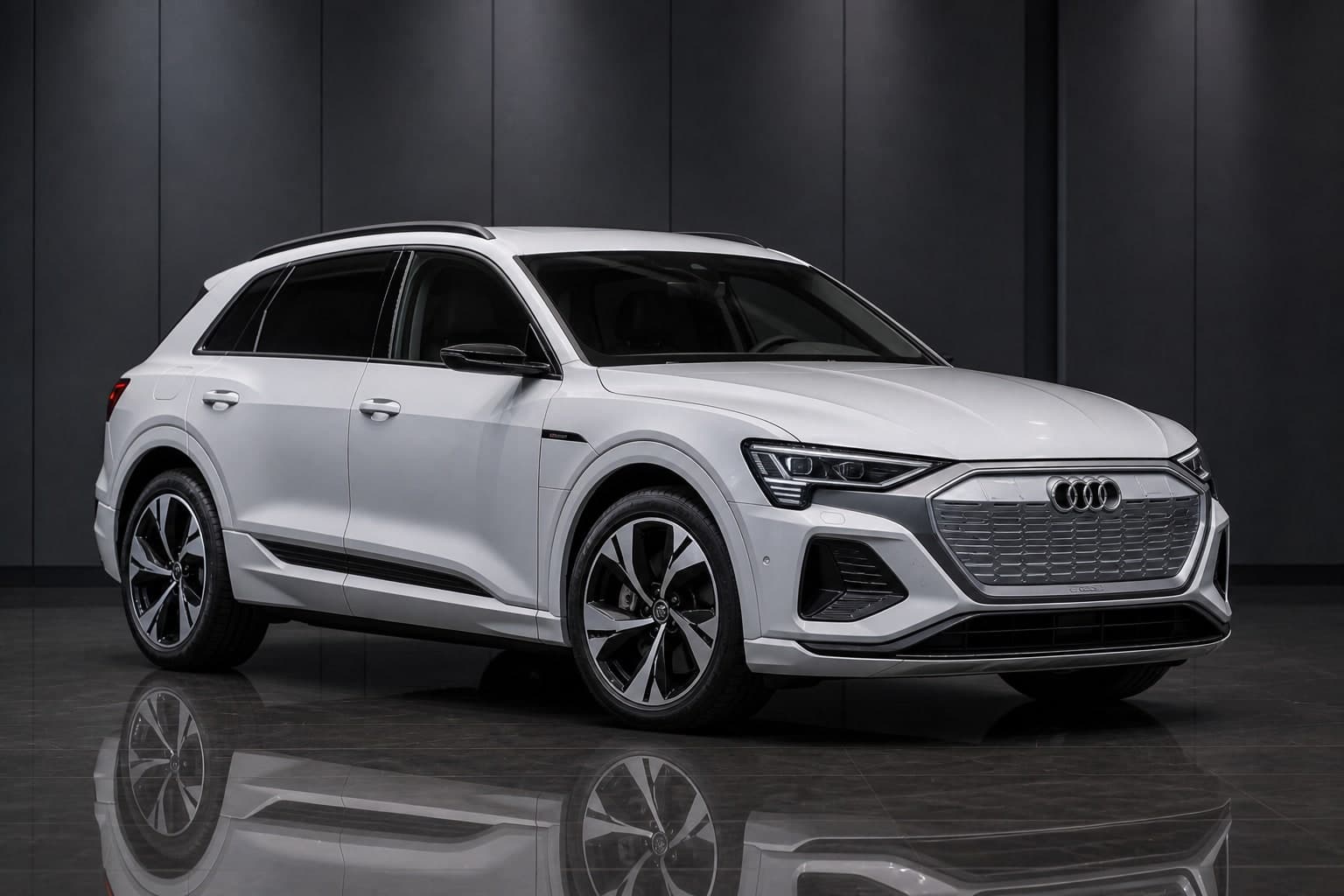
Latest Q8 e-tron News
Updated 2025- Global / productionGlobal
Production ended in Brussels
Audi’s 2024 annual reporting states that Q8 e-tron production at Brussels was discontinued at the end of February 2025.
2025Audi annual report
- Technical / renameGlobal
The e-tron became Q8 e-tron
The 2023 model-year update brought the Q8 e-tron name, revised design, improved efficiency, revised battery technology and higher charging capability.
2022/23Model update
- TechnicalEurope
Large-battery Q8 55 e-tron
The Q8 55 e-tron introduced a 106 kWh net / 114 kWh gross battery, up to 170 kW DC charging and WLTP range of up to 582 km for the SUV and 600 km for the Sportback in Audi’s published specification.
2022Audi technical data
Read first — EV ownership framing
For Q8 e-tron / e-tron, the most important ownership data is model year (e-tron vs Q8 rename), battery version, charging hardware, range honesty, thermal management, software, 12V, high-voltage systems, service history, charging history, battery health, recalls and market-specific specifications. Do not copy an ICE Q8 or PPE A6 e-tron checklist onto this car.
1. Generations & model evolution
Audi e-tron — 2018–2022
Audi’s first series-production fully electric model. Early versions included e-tron 50 quattro, e-tron 55 quattro and Sportback variants. Early e-tron 55 documentation specifies a 95 kWh gross / approximately 86 kWh net battery. Record VIN, model year, market, 50/55 version, body style, battery configuration, software and charging equipment.
Q8 e-tron — 2022/2023–2025
The updated model retained the established architecture while receiving revised styling, aerodynamic changes, improved efficiency, increased battery capacity, updated battery management and higher charging capability. Brussels production ended end of February 2025.
Market naming, equipment and exact outputs vary. Always tie power, battery, range and charging figures to derivative, model year and market — confirm VIN. Do not invent regional sales matrices.
2. Body styles
Q8 e-tron (SUV)
Conventional SUV body. WLTP range depends on Q8 50 / 55 / SQ8 derivative — see Range section.
Q8 Sportback e-tron
Sloping-roof Sportback. Typically longer official range than the equivalent SUV derivative in Audi’s published WLTP figures.
SQ8 e-tron
Performance SUV with three electric motors, 370 kW boost and 973 Nm — confirm market sheet.
SQ8 Sportback e-tron
Performance Sportback with the same three-motor quattro layout as SQ8 SUV.
3. Battery & high-voltage system
Always distinguish gross capacity from usable/net capacity. Exact pack depends on derivative and era — VIN is authoritative.
- Q8 50 (updated): 95 kWh gross / 89 kWh net · ~396 V nominal · DC up to 150 kW
- Q8 55 / SQ8: 114 kWh gross / 106 kWh net · ~396 V nominal · DC up to 170 kW
- AC: 11 kW standard · optional 22 kW depending on specification
- Record warranty status, SoH diagnostics, HV warnings, battery-module and cooling-system work as separate provenance — never infer health from displayed range alone
Early e-tron 55 pack framing (~95/86 kWh) differs from updated Q8-era figures. Chemistry and charging-curve details should come from Audi documentation for the VIN.
4. Powertrains
Electric drive only with quattro. Outputs below reflect Audi’s 2022 technical data for the updated Q8 range — confirm model year and market.
Q8 50 e-tron
Dual motor, quattro, up to 250 kW boost, 664 Nm, 0–100 km/h about 6.0 s, top speed 200 km/h. Battery 89/95 kWh net/gross. DC up to 150 kW.
Q8 55 e-tron
Dual motor, quattro, up to 300 kW boost, 664 Nm, 0–100 km/h about 5.6 s, top speed 200 km/h. Battery 106/114 kWh net/gross. DC up to 170 kW.
SQ8 e-tron
Three motors: one front and two rear. 370 kW boost, 973 Nm, 0–100 km/h about 4.5 s, top speed 210 km/h. Same 106/114 kWh pack as Q8 55. DC up to 170 kW.
Exact outputs, range and equipment are model-year and market specific. Use the market selector for regional framing — do not treat one country’s sheet as global.
5. Charging
- AC charging: 11 kW standard; optional 22 kW depending on specification
- DC charging: up to 150 kW on Q8 50; up to 170 kW on Q8 55 and SQ8
- Audi states around 31 minutes for 10–80% under suitable HPC conditions for Q8 50/55
- Actual performance depends on SoC, battery temperature, charger capability, preconditioning, ambient temperature, station and vehicle software
- Log AC/DC type, energy, start/end SoC, duration, maximum observed power, provider, location and faults — charging history is EV provenance
Maximum charging power is not guaranteed charging speed. Home wallbox sessions belong in charging records, separate from workshop service stamps.
6. Range — WLTP vs real-world
Always distinguish official test range from real-world distance. Audi’s published WLTP figures for the updated range (market- and equipment-dependent):
- Q8 50 SUV: up to 491 km · Q8 50 Sportback: up to 505 km
- Q8 55 SUV: up to 582 km · Q8 55 Sportback: up to 600 km
- SQ8 SUV: up to 458 km · SQ8 Sportback: up to 471 km
- Figures vary by market, equipment, wheels, tyres and test conditions
Real-world range varies with temperature, speed, weather, load, tyres, wheels, route, HVAC, driving style and battery condition. Range is not battery health.
7. Recuperation & braking
Regenerative braking and coasting are core EV ownership features. Record brake inspections, discs, pads, brake fluid, vibration, ABS/ESC warnings, wheel alignment and regenerative-braking issues. EV ownership does not remove the need to maintain friction brakes — regen can leave discs under-used and prone to corrosion.
8. Honest pros
- Large battery options (especially Q8 55 / SQ8)
- Strong long-distance capability for its generation
- quattro all-wheel drive across the range
- Premium cabin and comfort · large SUV practicality
- Useful charging capability for a 400V-class EV of this era
- Sportback alternative · mature real-world EV architecture
9. Honest cons / things to consider
- High vehicle weight · energy consumption can be high versus newer EVs
- 400V-class architecture is less advanced than newer 800V systems
- DC charging is slower than many newer EVs
- Tyre costs can be significant · complex electronics/ADAS can increase repair costs
- Battery-health evidence varies between used vehicles
- Production ended in 2025 — parts and dealer familiarity will evolve over time
10. Common owner-reported themes
Not diagnostic advice — these are themes owners may document in service records, workshops, forums or ownership reports. Do not treat them as confirmed defects unless supported by manufacturer documentation, recalls or reliable technical evidence.
Charging
Charging interruptions, slower-than-expected DC charging, wallbox communication and connector issues.
High-voltage system
Battery diagnostic results, HV warnings, charging-system faults, coolant/thermal-management work and battery repairs.
12V system
12V replacement, low-voltage warnings, parasitic-drain investigations and electrical faults — weak 12V can mimic HV faults.
Software
MMI, navigation, connectivity, myAudi, OTA/service updates and ADAS software.
Suspension, steering and tyres
Tyre wear, alignment, suspension, steering, air suspension where fitted and wheel damage.
Brakes
Disc corrosion, pad/disc replacement, brake-fluid service and regenerative-braking concerns.
11. Service & maintenance (EV)
The Q8 e-tron does not use a conventional ICE service schedule. Exact intervals must be resolved from market, model year, VIN and Audi documentation — never hard-code one global interval.
| Item | Typical interval | Notes |
|---|---|---|
| Scheduled EV inspection / service | Per Audi VIN schedule (often calendar-led) | GEV / e-tron family — not PPE A6 or MEB Q4 intervals. Confirm handbook / dealer system. |
| Brake fluid | Calendar (often ~24 months) | Fluid absorbs moisture even when regen reduces pad wear. |
| 12V battery test | Every service / sooner if symptoms | Load-test — separate from HV pack provenance. |
| Cabin / pollen filter | Often ~12 months | Annual habit on most EVs. |
| Tyres & alignment | Regular / every service | Heavy EV + torque — watch wear and efficiency wheels. |
| Brake pads / discs / corrosion | Every service | Regen can leave discs under-used — inspect for corrosion. |
| Coolant circuits / thermal system | Per Audi schedule | HV and cabin thermal loops — specialist EV work. |
| High-voltage system inspection | Per Audi schedule / campaign | Authorised EV technician — log warnings and repairs. |
| Software / MMI / ADAS check | At service or when prompted | Record version + date in Digital Service History. |
| Battery health / diagnostic (where offered) | Owner / dealer / third-party | Separate provenance event — not “range looks fine”. |
Service intervals and inspection requirements vary by market, model year and derivative. Always verify the VIN-specific Audi maintenance schedule.
12. EV battery health & provenance
Battery health is a dedicated provenance category for Q8 e-tron / e-tron. Distinguish manufacturer specification, measured battery health and estimated range.
- SoH % / diagnostic report, date, mileage, test type/provider, software version
- Measured capacity, HV work, battery-module work, cooling-system work
- Warranty status, HV warnings and battery-related repairs
- Store documents against the vehicle for resale / Transfer Pack
Never infer battery health from displayed range alone. Charging records should stay separate from workshop service stamps.
13. Inspection & roadworthiness
Terminology adapts by country — never title every market’s test “MOT”. UK MOT, Spain ITV, Poland/Hungary periodic inspection, Turkey TÜVTÜRK, US state systems, and other local rules.
- Record the local certificate separately from manufacturer service stamps
- Use the market selector for the local system name and authority links
- EV-specific items (HV isolation warnings, tyre condition, brakes) still matter at inspection
Confirm requirements for the vehicle’s registration market.
14. Recalls & campaigns
- Check VIN on official Audi / national safety portals for your market
- Log campaign number, date, mileage, dealer/workshop, work completed and supporting documents
- Do not assume a campaign from one market applies to every e-tron worldwide
Recall information must be VIN- and market-aware. Do not present a generic internet list as proof that a specific vehicle is affected. For an EV, distinguish battery-related, charging-system, software, ADAS, safety and high-voltage campaigns.
15. Official resources
Official links are for convenience. The Owners Club has no commercial relationship with Audi AG. Confirm manuals, charging and battery terms against your own documentation. VIN-specific information takes precedence over generic model information.
- Owner’s manual and dealer service system for your VIN — match model year and market
- myAudi and Audi Charging Service / local networks (market-specific)
- Regional Audi websites for warranty and battery information
16. Buying a used Q8 e-tron / e-tron
- Identity: VIN · model year · market · Q8 50 / 55 / SQ8 · SUV / Sportback · battery size · e-tron vs Q8 rename era
- Battery: health evidence, diagnostic report, HV warnings, charging history, warranty, previous HV repairs
- Charging: AC/DC test, connector, cables, faults, observed power
- Electrical: 12V age, warning history, MMI, myAudi, software version
- Chassis: tyres, wear, alignment, suspension, steering, brakes
- ADAS: cameras/radar/ultrasonic tested where fitted · calibration history after relevant repairs
- Documents: service history, invoices, recalls, inspections, battery-health evidence, charging equipment, ownership documentation
17. Own a Q8 e-tron? Protect its resale value
A strong Q8 e-tron provenance record can include VIN, ownership dates, mileage, charging history, battery-health reports, service visits, software updates, recalls, inspections, tyres, brakes, accident/repair documentation, charging equipment, photographs and invoices. Know your Q8 e-tron. Record its history. Connect with owners. Keep its story.
- Add Q8 e-tron to Garage — free digital ownership record
- Record battery health, charging history and software/OTA versions
- Track servicing, inspections, repairs and recalls with invoices
- Build a Transfer Pack for the next owner
Guides & checklists
More Audi models
Compare platforms, service themes and digital service history tools across the range.
FAQ
Is Q8 e-tron the same car as Audi e-tron?+
It is the direct evolution of the original Audi e-tron family. Audi renamed the updated model Q8 e-tron for the 2023 model year.
What battery sizes did it have?+
Updated Q8 50: 95 kWh gross / 89 kWh net. Q8 55 and SQ8: 114 kWh gross / 106 kWh net. Early e-tron 55 documentation specifies approximately 95 kWh gross / ~86 kWh net — confirm VIN.
How fast can it charge?+
Up to 150 kW DC for Q8 50 and up to 170 kW for Q8 55/SQ8. AC is 11 kW standard, with 22 kW optional depending on specification. Audi states around 31 minutes for 10–80% under suitable HPC conditions for Q8 50/55.
How far can it travel?+
Audi’s published WLTP figures for the updated range include Q8 55 SUV up to 582 km and Sportback up to 600 km. Real-world range varies with conditions.
Is it four-wheel drive?+
Yes. The Q8 e-tron range uses Audi electric quattro. SQ8 uses three motors (one front, two rear).
Is Q8 e-tron still produced?+
No. Audi’s 2024 reporting states Brussels production ended at the end of February 2025.
Q8 e-tron owner discussions
Latest conversations from Audi Q8 e-tron owners in the club.
No discussions yet for the Q8 e-tron. Be the first owner to start a conversation!
Ask a Question / Post PhotoJoin the Audi Owners Club Community
Add it to The Owners Club for free to track its maintenance timeline, import UK MOT history, and transfer verified provenance when you sell.