Owners Club · Digital service history
Nissan X-Trail Owners Club — Maintenance & Provenance
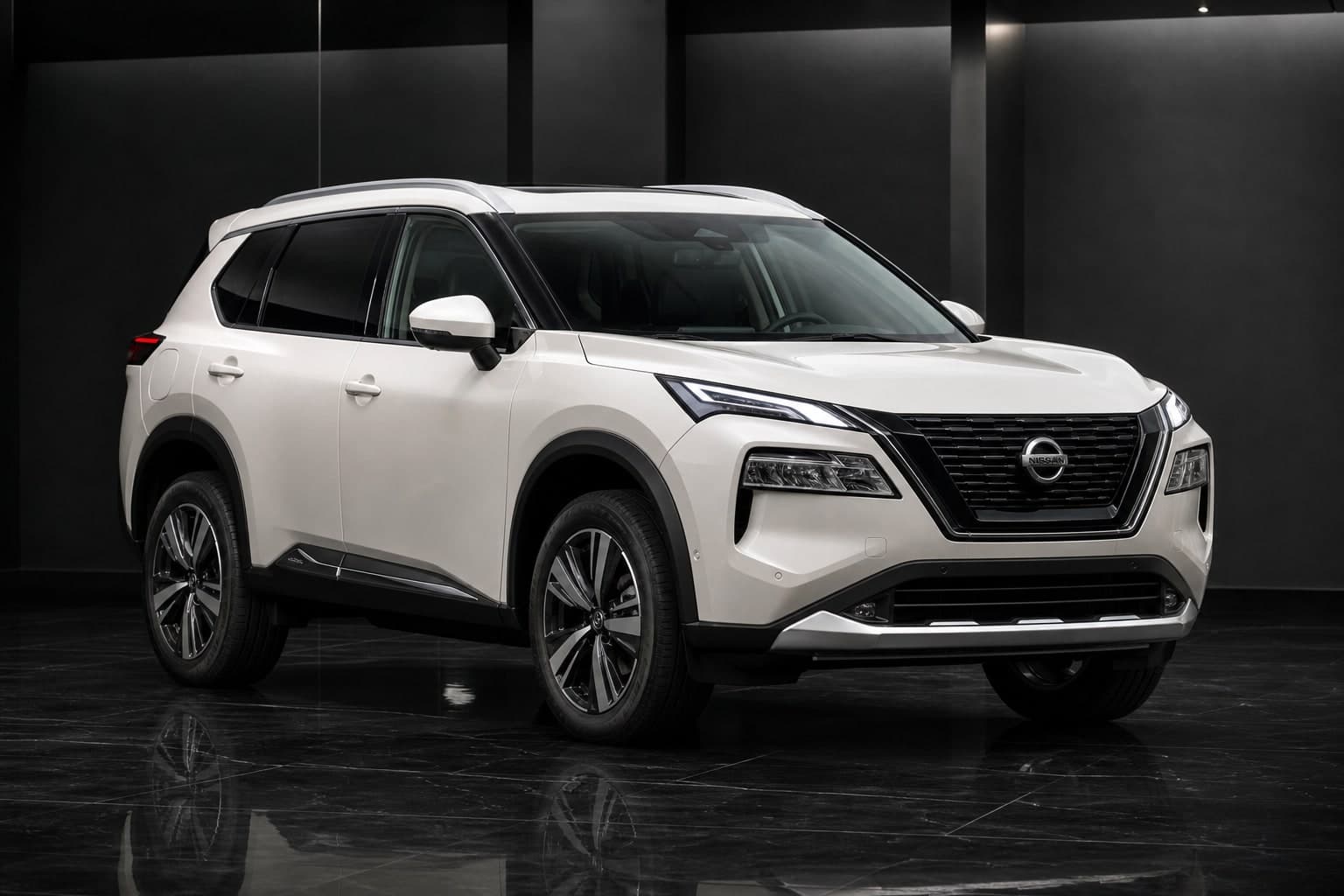
Independent owners’ resource. This page is produced by The Owners Club and is not affiliated with, endorsed by, or sponsored by Nissan Motor Corporation. Specifications, recall status and software details change — always confirm against your handbook (VIN) or an authorised Nissan dealer before booking work. The X-Trail has been Nissan’s practical, family-focused SUV since 2000, and the current fourth generation (T33, from 2021/2022) represents a genuine technological step up — a higher-quality interior, a more modern drivetrain lineup, and in Europe sold almost exclusively as an electrified model. It shares its CMF-C/D platform and e-POWER hybrid technology with the current Qashqai, which is why several known issues on this page overlap directly with that model’s.
This page covers the current T33 (2021/2022–present) and the previous T32 (2014–2022), which still makes up a significant share of the used market. Read this first if you have or are considering a T33 e-POWER model: a significant recall affecting the lithium-ion battery controller software was issued covering model years 2022–2026 — see the highlight and known issues below before assuming any power-loss symptom is unrelated.
Arrived from a club search? See the exact-match Nissan X-Trail Owners Club landing — then use this hub for platforms, issues and the full guide cluster.
Read this first — T33 e-POWER battery controller recall (2022–2026)
A significant recall covering model years 2022–2026 e-POWER X-Trails addresses a lithium-ion battery controller software defect. The fault can cause the vehicle to enter fail-safe mode — resulting in a loss of drive power while driving or during regenerative braking, and preventing the battery from charging. This is a genuine safety-relevant issue, not a minor glitch, and covers a substantial number of vehicles. If you own or are buying a T33 e-POWER from this build window, check recall status against the specific VIN with a Nissan dealer before assuming any power-related symptom is something else. Read this before the pros/cons below.
1. Generations & platforms
X-Trail T32 (2014–2022)
Predecessor Nissan platform · Diesel (R9M, R9N) and petrol (MR20DD) engine options with meaningfully different known-issue profiles by exact engine code · CVT automatic and start-stop systems both carry documented reliability concerns. “T32 X-Trail” alone does not tell you which risk profile applies — confirm the engine code.
X-Trail T33 (2021/2022–present)
CMF-C/D platform, shared with the current Qashqai · Available as 1.5 VC-Turbo mild hybrid or Nissan’s e-POWER series-hybrid system (the petrol engine only generates electricity; wheels are always electrically driven) · Available with 5 or 7 seats. The same e-POWER 12V behaviour pattern documented on the Qashqai applies here — see known issues and the Qashqai hub.
Treat T32 and T33 separately everywhere on this page. On T33, recalls currently dominate the known-issue picture more than long-term wear — normal for a still-young generation. On T32, verify the exact engine code before applying diesel or petrol themes from another code.
2. X-Trail: the Honest Pros
- Genuinely spacious, practical family SUV packaging, with a seven-seat option available on both generations
- The e-POWER drivetrain gives a smooth, EV-like driving experience without needing to plug in — the petrol engine only ever generates electricity, never driving the wheels directly
- Interior quality and technology took a clear step up on the T33 versus the T32
- Strong real-world comfort and refinement reported by many owners, particularly on longer journeys
- Shares platform and drivetrain technology with the Qashqai, which means a large body of cross-model ownership knowledge applies to both — see the Qashqai hub for overlapping e-POWER themes
3. X-Trail: the Honest Cons
- A significant, recent recall affects T33 e-POWER models (2022–2026 build) over a lithium-ion battery controller software fault — this is the single most important thing to check on a used e-POWER X-Trail right now
- e-POWER’s real-world fuel economy has been specifically criticised by reviewers as less impressive than the “EV-like” driving experience might suggest — don’t assume it matches a conventional hybrid’s efficiency
- The T33 is still a relatively young generation, so recalls currently dominate its known-issue picture more than long-term wear patterns — normal for a newer model, but worth factoring into how you read “known issues” for this generation
- The T32 (2014–2022), particularly diesel variants, has well-documented engine-specific weak points depending on exact engine code — not a single simple “avoid diesel” rule, but a genuinely engine-specific set of risks
- As with the Qashqai, e-POWER’s auxiliary 12V battery behaviour is a recurring theme in owner reports, distinct from more conventional car electrical faults
4. Known issues — check these before assuming a fault
Not diagnostic advice — themes owners often document in service history. Always verify for your exact engine, generation and year. T32 issues differ by engine code; T33 is still young, so recalls currently outweigh long-term wear themes.
T33 e-POWER — lithium-ion battery controller software fault (2022–2026 build, significant recall)
A software issue in the battery controller can cause the vehicle to enter fail-safe mode — resulting in a loss of drive power while driving or during regenerative braking, and preventing the battery from charging. This is a genuine safety-relevant fault, not a minor glitch, and covers a substantial number of vehicles. If you own or are buying a T33 e-POWER from this build window, check recall status against the specific VIN with a Nissan dealer before assuming any power-related symptom is something else.
T33 VC-Turbo — engine mount recall (“mount eater”)
A documented recall covering the 1.5 VC-Turbo engine’s mount. Confirm completion status against your VIN if your T33 has this engine rather than e-POWER.
T33 — additional early-production recalls
A breaking throttle-body gear, a fuel line that can come loose, and brake caliper bushes missing from the factory have all been documented on early T33 production. As a young generation, recalls currently make up a larger share of this model’s known-issue picture than long-term wear patterns — check all campaigns against your VIN rather than assuming only the battery controller recall is relevant.
T33 e-POWER — auxiliary (12V) battery failure
Documented in UK owner forums: a car that’s sat for a period without being driven can be found completely dead, with a flat 12V battery diagnosed as the cause even when the car had seemingly been used regularly in the preceding days. This mirrors the same underlying pattern documented on the Qashqai e-POWER — because the petrol engine in e-POWER models doesn’t run continuously the way a conventional alternator-charged car’s does, the 12V battery’s charging behaviour is genuinely different from what owners moving from a conventional car might expect. If you experience repeat 12V failures, ask specifically about this pattern rather than assuming a simple one-off battery fault. See also the Qashqai hub and the general 12V drain guide.
T33 — minor reported niggles
Wing mirror vibration that some owners report persisting even after a service visit, intermittent head-up display failures, and a “swishing” noise from the front suspension over speed bumps have all been mentioned in owner reviews. None of these are safety-critical, but worth checking on a test drive or pre-purchase inspection.
T32 (2014–2022) — engine-specific weak points, not a single blanket issue
Unlike some models where one issue dominates, the T32’s known issues vary meaningfully by exact engine code. R9M diesel (131PS): premature timing chain stretch, exhaust manifold cracks on twin-turbo (bi-turbo) variants, and EGR cooler leaks causing an exhaust smell and coolant loss. R9N diesel (150PS): head gasket failure linked to overheating, timing chain stretch, and DPF blockage from short-trip use. MR20DD petrol (144PS): timing chain elongation at higher mileage, cylinder head cracking (the aluminium head is sensitive to this), and intake valve carbon buildup — a common characteristic of direct-injection engines generally, not unique to Nissan. Confirm the exact engine code on any used T32 you’re considering — “T32 X-Trail” alone doesn’t tell you which of several genuinely different risk profiles applies.
T32 — general CVT and start-stop issues
As with several other Nissan models of this era, the CVT automatic and start-stop systems have a documented pattern of complaints on the T32. Diesel variants in particular saw frequent DPF and EGR valve issues linked to short, urban-heavy driving cycles.
5. UK service interval at a glance
| Service | Miles / months | Notes |
|---|---|---|
| Scheduled service (Nissan X-Trail) | 10,000 / 12 | Whichever comes first for many UK handbooks. Confirm exact figure for your engine/generation. |
| Recall/campaign check (T33) | — / At every service, and immediately if not yet checked | Given the significant e-POWER battery controller recall; don’t wait for a scheduled service to check this specifically. |
| 12V battery test (T33 e-POWER) | — / At every service, or sooner if symptoms appear | Different underlying charging behaviour from a conventional car — see known issues above. |
| DPF/EGR check (T32 diesel) | — / At every service | Especially relevant on cars mostly used for short trips. |
| Timing chain condition (T32, all engines) | — / At every service on higher-mileage examples | Documented stretch/elongation risk across R9M, R9N and MR20DD engines. |
| Cabin pollen filter | — / 12 | Standard interval for any vehicle. |
The X-Trail follows Nissan’s standard service scope, varying by generation, engine and drivetrain. UK cars typically need annual or ~10,000-mile attention, whichever comes first — confirm the exact figure for your specific engine and generation in the handbook. Intervals are whichever comes first (miles or months) unless noted. They vary by engine, generation, model year and service regime. Confirm in the handbook, service booklet or dealer system for your VIN before you book work. Legal note: Service intervals and specifications shown are indicative and collected from public or community sources. Official schedules may vary by model year, engine code, market, or dealer updates. Always verify the vehicle handbook (VIN) or consult an authorised dealer before work.
6. Official sources
Official links are for convenience and accuracy. The Owners Club has no commercial relationship with Nissan Motor Corporation and cannot confirm pricing, availability or booking on their behalf. Confirm the exact recall-checking URL on Nissan UK’s site before relying on it.
- Owner’s handbook and dealer system for your VIN — follow the edition matched to your model year, engine, generation and market
- VIN recall/campaign status with an authorised dealer — especially the T33 e-POWER battery controller campaign (2022–2026), plus VC-Turbo mount and other early T33 campaigns where fitted
7. What to actually keep on top of
- T33 e-POWER recall status, checked against the specific VIN — the lithium-ion battery controller software recall is the single most important thing to verify on this generation right now
- All other T33 recall campaigns — engine mount (VC-Turbo), throttle-body gear, fuel line, brake caliper bushes — given how many distinct campaigns exist on this still-young generation
- T33 e-POWER 12V battery behaviour, particularly if the car sits unused for periods — understand this is a different pattern from a conventional car’s charging behaviour, and the same theme documented on the Qashqai e-POWER
- Exact engine code on any T32 — the specific known issues differ meaningfully between the R9M diesel, R9N diesel and MR20DD petrol; don’t apply one engine’s risk profile to another
- DPF/EGR history on any diesel T32, especially if the car has done a lot of short urban trips
- General wear items flagged in owner reviews (wing mirror vibration, HUD reliability, front suspension noise) — minor, but worth factoring into a used-buying decision or a service conversation
8. Own a Nissan X-Trail? Protect its resale value
Add it to The Owners Club for free to track its maintenance timeline, import UK MOT history, and transfer verified provenance when you sell. Generation (T32 vs T33), exact engine code or e-POWER status, battery-controller recall completion and 12V notes are exactly what the next researched buyer will ask for.
- Verified maintenance timeline with garage invoices
- UK MOT import (DVSA)
- T33 e-POWER recall / 12V notes or T32 engine-code-specific checks
- Verified Transfer Pack PDF for sale
Guides & checklists
More Nissan models
Compare platforms, service themes and digital service history tools across the range.
FAQ
How often should you service a Nissan X-Trail?+
Most UK cars use an annual service or ~10,000 miles, whichever comes first. Confirm the exact figure for your specific engine and generation in the handbook.
What platforms does the Nissan X-Trail use?+
The current T33 (2021/2022–present) uses the CMF-C/D platform, shared with the current Qashqai, and is available as a mild-hybrid VC-Turbo or e-POWER series-hybrid. The previous T32 (2014–2022) used an earlier, related architecture with conventional diesel and petrol engine options.
Is there a recall I should check on my X-Trail e-POWER?+
Yes — a significant recall covers model years 2022–2026 e-POWER X-Trails, addressing a lithium-ion battery controller software fault that can cause a loss of drive power while driving or during regenerative braking, and can prevent the battery from charging. Check this specifically against your VIN with a Nissan dealer; there’s no cost to the owner for recall work.
Does “T32 X-Trail” tell me which reliability risks apply?+
No. The T32 has no single dominant issue — risks differ meaningfully by exact engine code (R9M diesel, R9N diesel, MR20DD petrol). Confirm the engine code on any used T32 before applying another engine’s risk profile.
How do I prove service history for a Nissan X-Trail?+
Document precisely which generation and drivetrain you have — T32 vs T33, and the exact engine code or e-POWER status — alongside dated invoices for the checks that matter to that car. Recall completion, especially the T33 e-POWER battery controller campaign, is worth documenting explicitly rather than assuming it’s covered by a general service record.
Is this page affiliated with Nissan?+
No. The Owners Club is an independent owners’ resource. Official Nissan links are for convenience only — we have no commercial relationship with Nissan and cannot confirm pricing, availability or booking on their behalf.
X-Trail owner discussions
Latest conversations from Nissan X-Trail owners in the club.
No discussions yet for the X-Trail. Be the first owner to start a conversation!
Ask a Question / Post PhotoJoin the Nissan Owners Club Community
Add it to The Owners Club for free to track its maintenance timeline, import UK MOT history, and transfer verified provenance when you sell.